How to Repair a Single-Handle Kitchen Faucet
To repair a single-handle kitchen faucet, shut off the water, identify where it leaks, then replace the worn cartridge, O-rings, hose, sprayer head, or handle. Clean the parts and test the faucet before closing the cabinet.
On this page (9 sections)
- What should you check before repairing a single-handle kitchen faucet?
- How do you shut off a single-handle kitchen faucet?
- How do you repair a leaking faucet cartridge?
- How do you repair a pull-down faucet hose?
- How do you replace a pull-down sprayer head?
- How do you repair a loose faucet handle?
- How do you test the repair?
- Which replacement should you choose?
- What is the safest way to finish a faucet repair?
To repair a single-handle kitchen faucet, shut off the water, locate the leak, and replace only the worn part. Most repairs involve the cartridge, O-rings, supply connection, pull-down hose, sprayer head, or handle.
Start by drying the faucet and cabinet completely. Then run the handle and watch where fresh water appears so you can match the repair to the problem.
What should you check before repairing a single-handle kitchen faucet?
Find the leak source before removing anything. Water around the handle, spout, sprayer, or cabinet floor points to different parts.
Check these areas:
- Water around the handle often means a worn cartridge or seal.
- A drip from the spout when the handle is closed can point to the cartridge.
- Water at the spray head may come from a loose connection, damaged screen, or worn sprayer.
- Water beneath the sink may come from a supply line, mounting connection, or pull-down hose.
- Weak flow can come from a blocked aerator, sprayer screen, or supply valve.
If you are comparing faucet designs before replacing a damaged unit, our kitchen faucet buying guide explains the main styles and installation points.
How do you shut off a single-handle kitchen faucet?
Close both shutoff valves under the sink before loosening the faucet. Turn the hot and cold valves clockwise, then open the faucet to release pressure.
Place a towel or shallow container below the connections. Keep the cabinet dry, and do not continue if a valve will not close or a connection is badly corroded.
Remove the handle carefully if the leak is near the faucet body. A small set screw may sit beneath a cap, on the side, or at the back of the handle.
How do you repair a leaking faucet cartridge?
Replace the cartridge when the faucet drips from the spout or leaks around the handle after the connections are dry. The exact cartridge depends on the brand, model, stem, retaining nut, and cartridge dimensions.
Remove the handle, decorative cover, retaining clip or nut, and old cartridge in that order. Take a photo before removing each part, and keep the pieces arranged so you can reinstall them correctly.
Mineral buildup can make the old cartridge difficult to lift. Use only a method approved for your faucet, and avoid scratching the valve body.
For help matching the replacement, see which replacement cartridge fits your kitchen faucet. Measure the old part and compare its stem shape before ordering.
What if the cartridge is fine but the handle is damaged?
Replace the handle when it is cracked, loose, stripped, or difficult to grip while the cartridge still operates correctly. The new handle must match the cartridge stem and attachment method.
The RXXR Faucet Lever Handle Replacement for 35mm fits 35mm cartridges with a 9x9mm square stem. It has a polished chrome finish, zinc alloy construction, a screw-on attachment, and hot and cold indicator markings.
The box includes 1 faucet lever handle, 1 hot and cold indicator button with red and blue markings, 1 screw, and 1 wrench. Check your stem dimensions before removing the old handle because a similar-looking lever may not fit.
If the faucet body leaks or the cartridge is worn, a handle alone will not solve the problem. For other handle options, compare best kitchen faucet replacement handles.
How do you repair a pull-down faucet hose?
Replace the pull-down hose when water leaks below the sink while the sprayer is in use, or when the hose is split or damaged. Confirm whether your faucet is pull-down or pull-out before choosing the part.
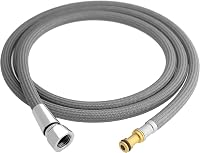
The Awelife 150259 Pull Down Hose Kit is a 68 in hose for Moen pull-down kitchen faucets using part numbers 150259 or 187108. It is not for pull-out models, which use a different hose kit.
The hose uses brass, metal, and nylon, with a 0.5 in outside diameter and a brass end fitting designed to rotate freely. Its included component is the hose, so keep any faucet-specific clips or weights from the original installation if your faucet uses them.
Disconnect the old hose at the faucet and spray head, noting the routing through the cabinet. Feed the replacement through the same path, reconnect it without cross-threading, and check for kinks before turning the valves back on.
For more repair options, compare best kitchen faucet replacement parts. Match the faucet brand and model before ordering.
How do you replace a pull-down sprayer head?
Replace the sprayer head when the hose connection leaks, the head is cracked, or its spray pattern stays blocked after cleaning. Unscrew the old head, inspect the gasket, and install the replacement without overtightening.
The J-HVA Pull Down Kitchen Faucet Sprayer Head is a brushed nickel replacement with stream, spray, and blade spray modes. It has an M24x1 thread, a 1.8 gpm flow rate, and an ABS body with silicone nozzles.
It includes 15 connectors, a gadget, a manual, and 1 pull-down kitchen faucet sprayer head. The stated compatible brands include American Standard, Kohler, Hansgrohe, Grohe, Moen, and Delta, but it is not compatible with every faucet.
Compare the thread and connector with your old sprayer before installation. Clean mineral deposits from the hose end, place the gasket correctly, and hand-tighten first to protect the threads.
The blade spray mode may help flush food debris, while stream mode suits filling and spray mode suits rinsing. Use the gentlest mode that handles the task, and clean the silicone nozzles when flow becomes uneven.
How do you repair a loose faucet handle?
A loose handle usually needs its screw tightened, its stem connection cleaned, or the handle replaced. Shut off the water first if you need to remove the handle.
Remove the cap and set screw, then lift the handle and inspect the square stem and screw hole. Wipe away mineral buildup without damaging the cartridge stem.
If the handle still slips after tightening, check whether the stem or handle opening is worn. A replacement must match both the cartridge size and stem shape.
For a repair kit with several common parts, see the best single-handle kitchen faucet repair kit. If you are changing the whole fixture, best Delta single-handle kitchen faucet options may help with brand-specific comparisons.
How do you test the repair?
Open both shutoff valves slowly and check every connection with a dry paper towel. Run cold and hot water separately, then move the handle through its normal range.
Inspect the faucet body, handle, sprayer connection, hose, and valves under the sink. Pull the spray head out and return it several times if the faucet has a pull-down design.
Let the water run long enough to clear loose debris, then close the handle and watch the spout. If water returns after the repair, shut off the valves and recheck the cartridge orientation, gasket, thread, and retaining hardware.
Do not use thread sealant or tape where the faucet uses a rubber gasket to seal. Use only the connection method intended for that fitting.
Which replacement should you choose?
Choose the part that matches the leak and the faucet's exact connection details. A cartridge repair suits a dripping spout, a handle suits a damaged lever, a hose suits a leak below the sink, and a sprayer head suits a damaged or blocked nozzle.
Choose the Awelife hose only for compatible Moen pull-down faucets using 150259 or 187108. Choose the J-HVA sprayer head after checking the M24x1 thread and connector fit.
Choose the RXXR handle only when your faucet has a 35mm cartridge with a 9x9mm square stem.
For other finishes and mounting styles, compare best brushed nickel single handle kitchen faucet choices and best single handle wall-mount kitchen faucets.
What is the safest way to finish a faucet repair?
Dry the cabinet, confirm there are no slow leaks, and keep the old part until the repair is proven. Check again after the faucet has been used several times.
Pick a cartridge repair when water comes from the spout or handle. Pick the Awelife hose for a matching Moen pull-down hose problem, the J-HVA head for a compatible sprayer replacement, and the RXXR handle for a matching 35mm cartridge and square stem.
If the faucet body, mounting shank, or valve area is cracked, a replacement faucet may be more practical than repeated part changes. The best repair is the one that matches the leak instead of replacing unrelated components.
Frequently asked questions
What is the most common cause of a single-handle kitchen faucet leak?
A worn cartridge, damaged O-ring, loose connection, or blocked aerator can cause a single-handle kitchen faucet to leak. Water at the handle often points to the cartridge or seals, while water under the sink may come from supply connections or a pull-down hose.
Shut off water before removing parts.
How do you remove a single-handle kitchen faucet handle?
Turn off the hot and cold shutoff valves, then find the handle's set screw or retaining cap. Remove the screw with the correct tool, lift the handle straight off, and keep small parts together.
Do not force the handle if mineral buildup has bonded it to the stem.
Can you repair a leaking kitchen faucet without replacing the whole faucet?
Yes, many leaks can be repaired by replacing the cartridge, O-rings, hose, sprayer head, or handle. Match the replacement to the faucet brand, model, cartridge size, stem shape, and connection type.
If the faucet body or mounting area is cracked, replacement of the whole faucet may be safer.
How do you know which faucet cartridge to buy?
Match the cartridge by faucet brand, model, shape, length, stem design, and retaining method. Remove the old cartridge only after shutting off the water, then compare it with the replacement.
Our guide to kitchen faucet cartridge replacement explains the measurements that matter.