Which Replacement Cartridge Fits Your Kitchen Faucet?
The right kitchen faucet cartridge replacement matches your faucet brand, valve design, dimensions, stem and handle setup. Remove the handle and old cartridge only after shutting off the water, then compare every measurement.
On this page (10 sections)
- Which details identify a kitchen faucet cartridge?
- How does the faucet brand narrow the cartridge search?
- What valve design does your faucet use?
- How do you measure a cartridge for kitchen faucet replacement?
- Does the handle configuration affect cartridge fit?
- Which related replacement parts may solve the problem?
- How do you replace a kitchen faucet cartridge?
- What should you check after installing the cartridge?
- When should you replace the faucet instead?
- Final kitchen faucet cartridge replacement rule
The right kitchen faucet cartridge replacement matches the faucet's brand, valve design, dimensions, stem and handle configuration. A cartridge that looks close can still fail to fit if its diameter, height, stem or retaining method is different.
Start with the faucet model if you can find it. If the model is missing, shut off the water and compare the removed cartridge with replacement measurements before you buy.
Which details identify a kitchen faucet cartridge?
The most useful identification details are brand, model, valve style, cartridge size and stem shape. Handle position and the way the cartridge is held inside the faucet provide extra checks.
Look for a brand name or model number on the faucet body, base plate, supply paperwork or the underside of the spout. A logo alone may narrow the search, but it usually does not identify the exact cartridge.
Record these details before ordering:
- Faucet brand and model
- Single-handle or two-handle design
- Cartridge or valve type
- Cartridge diameter and height
- Stem shape, length and splines
- Retaining nut, clip or sleeve design
- Hot and cold orientation
- Faucet age, if known
Take a clear photo of the handle, retaining hardware and old cartridge. Keep the removed part until the new cartridge is installed and tested.
For broader faucet choices, see our kitchen faucet complete buying guide. It explains how faucet design, handle style and installation details affect the rest of the system.
How does the faucet brand narrow the cartridge search?
The faucet brand narrows the search, but brand matching alone is not enough. One manufacturer can use several cartridge designs across different models and production periods.
Moen, Delta, Kohler, American Standard, Grohe and Hansgrohe faucets may each use different internal parts. Some brands also change valve designs between single-handle and two-handle faucets.
Search the model number with terms such as “cartridge,” “valve” or “replacement part.” If you cannot find the model, compare the original cartridge's measurements and stem with the replacement specifications.
For a Kraus faucet, use our guide to Kraus kitchen faucet cartridge replacement. A brand-specific guide can help separate model families that use different internal parts.
What valve design does your faucet use?
The valve design tells you what kind of internal part to look for. Single-handle faucets usually use one cartridge or ceramic valve to control both flow and temperature, while two-handle faucets commonly use separate hot and cold valves.
A single-handle faucet may have a round, square or splined stem beneath the handle. The stem must match the handle connection, not just the cartridge body.
Two-handle faucets may use compression, ceramic-disc, ball or cartridge-style valves. These designs are not interchangeable, so identify the internal mechanism before ordering.
A diverter is different from the main cartridge. It redirects water between outlets or spray functions, so a faucet with weak flow at a side sprayer may need a diverter rather than a cartridge.
If your faucet has a Moen spray function, compare the issue with our guide to replacement diverter valves for Moen kitchen faucets.
How do you measure a cartridge for kitchen faucet replacement?
Measure the cartridge body, stem and mounting features, not just the outside faucet opening. Small differences can prevent the cartridge from seating or allow leaks around the valve.
Measure the old cartridge after removal:
- Measure the widest part of the cartridge body.
- Measure total height from the base to the top of the stem.
- Measure the stem length above the cartridge body.
- Record the stem shape, such as square, flat-sided or splined.
- Note locating tabs, holes, notches and alignment marks.
- Photograph the retaining clip, nut, sleeve or cap.
Use the same units for every measurement. Compare the old part beside the replacement, with both stems facing the same direction.
Do not force a cartridge that stops halfway into the valve body. The cause may be the wrong size, a misplaced seal, mineral buildup or an incorrect orientation.
Our guide to best replacement valves for kitchen faucets can help when the part you need is described as a valve rather than a cartridge.
Does the handle configuration affect cartridge fit?
The handle configuration affects fit because the handle must connect to the cartridge stem and move through the faucet's intended range. A compatible cartridge with the wrong stem can still leave the handle loose or unusable.
Single-handle faucets use one control for hot, cold and flow. Confirm whether the handle attaches with a screw, set screw, adapter or direct stem connection.
Two-handle faucets need the correct hot or cold valve position. Some cartridges are side-specific, while others can be rotated during installation.
A loose handle does not always mean the cartridge is bad. The problem may be a worn screw, damaged stem or incompatible handle.
For handle options, see our guide to best kitchen faucet replacement handles. It helps separate handle problems from internal valve problems.
Which related replacement parts may solve the problem?
Choose the part that matches the symptom. A cartridge controls internal flow and temperature, while a hose, sprayer head or handle solves a different problem.
A dripping handle, difficult temperature control or water that will not shut off can point toward a cartridge or valve issue. A loose handle may require handle hardware instead.
A damaged pull-down hose needs a hose replacement rather than a cartridge. The Awelife 150259 Pull Down Hose Kit is a 68 in hose kit for Moen pull-down kitchen faucets using part number 150259 or 187108, not pull-out models.
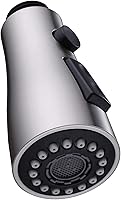
A blocked or damaged spray head also does not call for a cartridge. The J-HVA Pull Down Kitchen Faucet Sprayer Head has a brushed nickel finish, M24x1 thread size, 1.8 gpm flow rate, 3 water modes and 15 adapters.
A worn handle can make a good cartridge feel loose or difficult to control. The RXXR Faucet Lever Handle Replacement for 35mm fits 35 mm cartridges with a 9 x 9 mm square stem and includes a handle, hot and cold indicator button, screw and wrench.
How do you replace a kitchen faucet cartridge?
Replace a kitchen faucet cartridge by shutting off both water supplies, relieving pressure, removing the handle and retaining hardware, then installing the new cartridge in the same orientation. Keep small parts in order as you remove them.
Use these general steps:
- Close the hot and cold shutoff valves under the sink.
- Open the faucet to release pressure and confirm that water stops.
- Cover the drain so screws and clips cannot fall inside.
- Remove the handle cap, set screw or mounting screw.
- Lift off the handle and remove the retaining nut, clip or sleeve.
- Pull out the old cartridge without damaging the valve housing.
- Clean loose mineral deposits from the opening.
- Compare the replacement with the old cartridge.
- Align the tabs, holes and hot-cold orientation.
- Reinstall the retaining parts and handle.
- Open the shutoff valves slowly.
- Check for leaks and confirm temperature control.
Follow the faucet manufacturer's instructions when they differ from this general process. Some cartridges need a special puller, while others can be removed by hand after the retaining parts are removed.
If you need a broader repair sequence, read how to repair a single-handle kitchen faucet. It covers the handle, cartridge and related checks in one workflow.
What should you check after installing the cartridge?
After installation, check leaks, handle movement, hot-cold direction and water flow. A cartridge can seem fitted while still being misaligned or held by an incomplete retaining connection.
Run cold water first, then hot water. Move the handle slowly through its range and inspect the base, handle area and supply connections.
If the handle moves backward, the cartridge may be rotated incorrectly. If the faucet leaks around the cartridge, check the seals, retaining hardware and cartridge seating.
If flow remains weak, remove and clean the aerator before assuming the new cartridge failed. Sediment in the aerator can restrict water even when the valve works correctly.
Do not keep tightening parts that still leak. Excess force can damage threads, seals or the faucet body.
When should you replace the faucet instead?
Replace the whole faucet when the body, valve housing, connections or finish are damaged beyond a practical repair. A cartridge replacement makes more sense when the faucet body is sound and the internal part is the clear source of the problem.
Consider a new faucet if:
- The valve housing is cracked
- Threads are stripped
- Supply connections leak from corrosion
- Replacement parts are unavailable
- The faucet has several unrelated failures
- Repair parts cost too much for the faucet's condition
A cartridge is usually the better first step when the faucet only drips, sticks or has poor temperature control. Identify the original part before disassembling anything.
Final kitchen faucet cartridge replacement rule
Choose a kitchen faucet cartridge replacement by model first, then confirm valve design, dimensions, stem and handle connection. If those details do not match, stop and identify the faucet again instead of forcing the part.
Pick a cartridge when the internal valve causes the problem. Pick a hose, sprayer head or handle when that separate component is damaged.
For replacement-part options, see our guide to best kitchen faucet replacement parts and repair kits.
Frequently asked questions
How do I know which cartridge fits my kitchen faucet?
Match the faucet brand, model or part number, valve design, cartridge dimensions, stem shape and handle configuration. Remove the handle and compare the old cartridge with the replacement before ordering.
A similar-looking cartridge can still have a different height, diameter, stem or retaining method.
Are kitchen faucet cartridges universal?
Kitchen faucet cartridges are not universally interchangeable. Some replacement cartridges fit several faucet models, but brand, valve design, diameter, height, stem shape and mounting details still matter.
Use the faucet model or the old cartridge as your reference instead of choosing by appearance alone.
Can I replace a kitchen faucet cartridge without replacing the faucet?
You can often replace a kitchen faucet cartridge without replacing the whole faucet if the body, valve housing and connections remain sound. Shut off the water, remove the handle and retaining parts, pull out the old cartridge and install a matching replacement with the correct orientation.
What is the difference between a faucet cartridge and a valve?
A cartridge is the removable internal part that controls water flow and temperature in many single-handle faucets. A valve can mean the cartridge itself or the broader valve assembly inside the faucet.
Check the faucet's terminology, model number and internal design before ordering.