How to Replace a Pull Down Kitchen Faucet Aerator
A pull down kitchen faucet aerator replacement starts by removing the spray head, checking the aerator and thread, then fitting the correct replacement without cross-threading. Shut off the water supply only if the spray head will not stop dripping.
On this page (9 sections)
- What should you check before replacing the aerator?
- What tools do you need for a pull down kitchen faucet aerator replacement?
- How do you remove the pull down spray head?
- How do you clean and inspect the old aerator?
- Which replacement aerator suits a pull down spray head?
- How do you install the new aerator?
- How do you check the repair for leaks?
- What if the pull down faucet still has weak flow?
- When should you replace the whole spray head?
A pull down kitchen faucet aerator replacement starts by removing the spray head, checking the aerator and thread, then fitting the correct replacement without cross-threading. Shut off the water supply only if the spray head will not stop dripping.
The aerator is the small outlet piece that shapes the stream as water leaves the faucet. On a pull down faucet, it may sit inside the removable spray head, so the job is different from replacing an aerator screwed directly onto a fixed spout.
Your faucet may have a serviceable screen, insert, or outlet fitting. If the spray head is sealed, cracked, or leaking around its body, replacing the whole head may be safer than forcing an internal part.
What should you check before replacing the aerator?
Check whether the spray head has a removable outlet, then identify the thread size and washer arrangement. A correct thread match matters more than choosing an aerator with extra spray settings.
Pull the spray head down and disconnect it from the hose only if your faucet design allows this. Keep the hose from slipping back into the spout, and place a towel over the sink drain so a small washer cannot disappear.
Look at the end of the spray head. You may see a threaded aerator, a recessed screen, or a molded outlet with no removable edge.
Do not pry at a sealed plastic face or insert a sharp tool into the water holes.
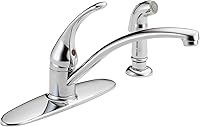
If you are unsure which part you have, this guide to kitchen faucets can help you compare common faucet designs before you order a replacement.
What tools do you need for a pull down kitchen faucet aerator replacement?
You usually need a cloth, a soft brush, and a correctly sized faucet wrench. Use adjustable pliers only with strong protection around the finish, because plated surfaces can mark or deform.
A cloth gives you grip while protecting chrome or another finish. A soft brush can clear loose scale from the screen, but it should not be used to enlarge holes or scrape the fitting.
The KLEIN TOOLS 68098 12-in-1 Faucet Wrench is designed for faucet, sink, and toilet repairs. Its detachable metal piece includes an aerator wrench for junior-sized aerators, while the tool also has several hex-wrench sizes and a handle that extends up to 14 1/2 in.
Choose this tool when you expect to work on more than one faucet fitting. Its aerator section may not match every pull down spray head, so confirm the outlet shape before applying force.
For more options, see our guide to the best kitchen faucet aerator removal tool.
How do you remove the pull down spray head?
Hold the spray head firmly, turn the removable aerator or retaining ring counterclockwise, and stop if the fitting begins to deform. Work over the sink with the drain covered.
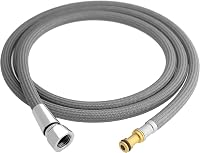
If the spray head separates from the hose, keep the hose supported. Some faucets use a quick connection, while others keep the head attached during the aerator repair.
Wrap the fitting in a thin cloth before using a wrench. Turn slowly and keep the wrench square to the fitting.
A tilted tool can round the edges and make the part harder to remove.
If mineral buildup makes the part stiff, rinse the outside first and use gentle repeated movement. Do not use a knife, screwdriver, or hard pick to force the aerator out.
Our guide to how to remove a faucet aerator covers the same protection and grip principles for fixed and removable faucet outlets.
How do you clean and inspect the old aerator?
Rinse the removed insert, inspect the screen and washer, and replace damaged parts instead of reinstalling them. A clogged screen can reduce flow, but a torn washer can cause leaks or a crooked stream.
Hold the aerator over a bowl while separating its pieces. Note the order of the screen, insert, gasket, and retaining ring before cleaning.
Rinse away loose particles with clean water. Use a soft brush around the screen, and check that the openings remain clear.
If the screen is bent, split, or packed with hard scale, a new aerator may be more reliable.
Measure the old part and compare its thread direction. Female threads fit over a male faucet outlet, while a female faucet outlet needs a matching male connection or an adapter.
The best replacement kitchen faucet aerators guide can help if the old part is too damaged to identify.
Which replacement aerator suits a pull down spray head?
Choose a replacement that matches the spray head's thread, space, and intended flow pattern. A swivel extender may be useful at a fixed sink outlet, but it can be too large for a pull down spray head.
The Hibbent NSF/ANSI/CAN 61 Certified Faucet Aerator has a 55/64 in female thread, a chrome finish, a 1.8 gpm flow rate, and 2 water-flow designs: soft aerated water and strong spray. It has a 360-degree swivel, a metal body and swivel ball joint, and includes a female-to-male adapter.
This Hibbent model suits a pull down spray head only when the outlet and available space match its dimensions and connection. Its swivel body may be more useful on a compatible fixed or compact outlet than inside a tight spray head.
The Patented CECEFIN Swivel Faucet Extender Sink Aerator has brass connectors and arm, an ABS aerator body, 2 flow modes, and a 1.2 gpm maximum flow rate. It includes 3 washers and 2 wrenches, with connections for female G1/2, female 55/64 in, and female 15/16 in threads.
CECEFIN is better suited to a faucet outlet with enough room for its rotating arm. It is not designed for an added filter cartridge, so it should not be chosen when that is part of your plan.
For brand-specific fit questions, compare our guides to Moen kitchen faucet aerator replacement and Delta kitchen faucet aerator replacement.
How do you install the new aerator?
Place the washer and screen in the correct order, start the threads by hand, and tighten only until the connection is secure. Cross-threading is the most common avoidable mistake during installation.
Rinse the new part if the instructions allow it, then fit the washer flat against its seat. Start the aerator or retaining ring by turning it clockwise with your fingers.
If it stops after only a partial turn, remove it and start again. Do not use a wrench to force a fitting that does not turn smoothly by hand.
Once the part is seated, use a cloth-covered wrench for a small final turn if needed. Reconnect the spray head and hose, making sure the hose is not twisted.
How do you check the repair for leaks?
Run the faucet slowly, switch between spray modes, and inspect every connection for drips. Check the spray head joint, washer edge, hose connection, and outlet.
Start with cold water at low flow. Increase the flow gradually and observe the stream for side spray or uneven output.
If water leaks around the thread, turn off the faucet and remove the aerator. Check that the washer is flat, the thread is clean, and the part is the right size.
A spray from the seam usually means the washer is misplaced or the fitting is cross-threaded. Reinstall it by hand rather than adding more force.
The EPA's WaterSense information for residential kitchen faucets explains how efficient faucet flow can reduce water use while maintaining useful performance.
What if the pull down faucet still has weak flow?
Weak flow after replacement usually points to a blocked screen, a closed supply valve, a kinked hose, or a mismatch between the new part and the spray head. Check the simplest causes before replacing more components.
Remove and rinse the aerator again. Look for grit that may have entered the outlet during the repair.
Confirm that the water supply valves are open and that the pull down hose moves freely beneath the sink. A bent or trapped hose can restrict flow even when the aerator is clean.
If the spray head has a built-in diverter or sealed filter, the aerator may not be the only restriction. Follow the faucet manual before disassembling the head further.
When should you replace the whole spray head?
Replace the whole spray head when the outlet is sealed, the body is cracked, the hose connection leaks, or the internal fitting cannot be removed without damage. A new aerator cannot repair a damaged spray head body.
Choose a replacement head only after measuring the hose connection and checking the faucet brand's parts information. A head that fits the hose may still have the wrong diverter or connection.
For a wider faucet project, our guide to kitchen faucet replacement explains when replacing the complete faucet makes more sense.
A pull down kitchen faucet aerator replacement is complete when the new part fits by hand, the washer sits flat, both spray modes work as intended, and no connection drips. Pick Hibbent for a compatible 55/64 in female-thread aerator, KLEIN TOOLS for a removal tool, or CECEFIN when a larger swivel extender fits your outlet.
Frequently asked questions
Can you replace the aerator in a pull down kitchen faucet?
Yes, if the pull down spray head has a removable aerator or screen. Unscrew the spray head from the hose, inspect the outlet and insert, then replace only the matching part.
Some spray heads use a sealed design, so replacing the entire head may be the practical option.
How do you remove a stuck pull down faucet aerator?
Protect the finish with a cloth, then use light, even pressure with a wrench made for faucet fittings. Avoid crushing the spray head or gripping the hose.
If mineral buildup prevents movement, soak the removable end in vinegar only when the faucet maker allows it.
What size aerator fits a kitchen faucet?
The correct size depends on the faucet's outlet thread and the aerator design. Common sizes include 55/64 in female threads and other male or female fittings.
Measure the old part and compare the thread direction before ordering.
Why does a pull down faucet spray after replacing the aerator?
Spraying often means the aerator, washer, or screen is not seated squarely, or the replacement does not match the outlet. Remove it, rinse the parts, check the washer, and reinstall by hand before using a tool for the final small turn.