Apartment Size Dishwasher Dimensions: Check the Fit
Apartment-size dishwasher dimensions depend on the style: measure the countertop footprint, the height below cabinets, and the space for hoses and door access. Then compare those measurements with the dishes you need to wash.
On this page (7 sections)
- What apartment-size dishwasher dimensions should you measure?
- How much clearance does a countertop dishwasher need?
- How do you check cabinet openings and countertop space?
- How do dish size and capacity affect the fit?
- How should you plan faucet and drain connections?
- What is a simple way to check the fit before choosing?
- Which apartment-size dishwasher dimensions point to a good fit?
Apartment-size dishwasher dimensions vary by style, so measure the available space and the dishes you need to wash before choosing a model. For a countertop unit, check its width, depth and height, plus the room needed for the door, faucet connection and drain hose.
A cabinet opening is only one part of the fit. Also check whether the unit blocks a sink, outlet or work area, and whether your plates fit inside.
For a wider comparison of best dishwashers for small spaces, consider which style suits your kitchen before settling on a footprint.
What apartment-size dishwasher dimensions should you measure?
Measure the outside width, depth and height of the machine, then compare them with the usable space where it will sit. Dimensions alone don't include clearance for opening, loading or connecting hoses.
For a countertop dishwasher, measure the counter area and the vertical gap below any cabinet or shelf. For a built-in or drawer model, measure the opening at the front, middle and back because walls and cabinets may not be perfectly square.
| Measurement | Where to measure | Why it matters |
|---|---|---|
| Width | Across the counter or cabinet opening | Confirms the unit fits without crowding nearby items |
| Depth | From the wall or backsplash to the counter edge | Leaves space for the body, connections and front access |
| Height | Countertop to the lowest cabinet or shelf | Confirms the machine clears overhead obstructions |
| Door clearance | In front of the closed machine | Allows the door to open and dishes to be loaded |
| Hose reach | From the connections to faucet and drain | Confirms the supplied hoses can reach their intended positions |
Measure around fixed obstacles such as trim, pipes, backsplash lips and outlet covers. Use the smallest reading when dimensions differ across the space.
Compare more small dishwasher dimensions if you are deciding between compact styles or need a broader size reference.
How much clearance does a countertop dishwasher need?
A countertop dishwasher needs enough overhead room to fit and enough open space to use it. Check the manufacturer's instructions for required spacing, since clearance can vary by model.
As one specific example, COMFEE' says to leave more than 19.6 in between the countertop and wall cupboard for its portable mini dishwasher. Its listed height is 17.24 in, so the remaining space helps show why machine height alone may not settle the fit.
Measure from the counter surface to the lowest point of the cabinet, including any trim. Check whether the door opens without hitting a cabinet pull, shelf or window ledge.
Think about everyday use too. A unit may physically fit in a corner but make the main prep area hard to use, or leave too little space to fill and unload it.
How do you check cabinet openings and countertop space?
Measure the actual opening, not the cabinet's advertised size. Take width, depth and height readings at more than one point, then compare the smallest values with the machine's dimensions.
For a countertop model, mark its footprint with painter's tape or a paper template. This makes it easier to see whether it crowds the sink, blocks an outlet or reduces space for food preparation.
For a cabinet installation, check the path from the opening to the sink and faucet. Confirm that hoses can pass without being pinched and that the door can swing open fully.
If you're considering a single drawer dishwasher, measure the opening and check the model's installation requirements. Drawer units may need a different kind of cabinet fit than a portable countertop model.
How do dish size and capacity affect the fit?
A dishwasher can fit your counter and still be too small for your everyday dishes. Check the maximum plate diameter and capacity details, then compare them with the largest plates, bowls and cookware you regularly use.
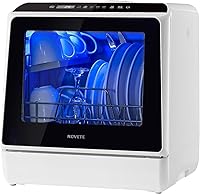
For example, NOVETE gives outside dimensions of 16.9 in wide, 16.8 in deep and 18.1 in high, and says it can fit dishes up to 12 in loaded at an angle. COMFEE' gives a maximum plate size of 9.5 in for its mini model.
Capacity labels are not interchangeable across styles. A countertop dishwasher's place-setting count may not predict whether a wide dinner plate or tall glass fits, so compare the item's shape and loading direction as well.
How should you plan faucet and drain connections?
Check the route and reach of the inlet and drain hoses before placing a countertop dishwasher. A snug footprint is not enough if the faucet adapter cannot connect or the drain hose cannot reach its intended outlet.
Measure from the proposed machine position to the faucet connection and drain point. Leave enough slack for safe routing, but keep hoses away from sharp edges and locations where they could be crushed.
Some portable units can use a built-in tank as well as a faucet connection. NOVETE's product information describes both options, while the COMFEE' mini model can be filled manually or connected to a faucet with its included hose and adapter.
If you need to check the faucet connection, use the Faucet Adapter Size Chart for Countertop Dishwasher.
What is a simple way to check the fit before choosing?
Use a short measurement checklist and compare every number with the exact model you are considering.
- Measure the available width, depth and height.
- Record the smallest measurement if the space varies.
- Add the door-opening and loading area in front.
- Check required overhead and side clearances in the instructions.
- Measure the faucet and drain route.
- Compare the machine's dish-size limit with your largest plates.
- Confirm the unit will not block a sink, outlet or useful counter area.
For an apartment, a portable unit can be easier to place than a cabinet-installed model, but it still needs a stable surface and workable water and drain access. Choose based on the space you can measure, rather than a broad label such as “compact.”
Which apartment-size dishwasher dimensions point to a good fit?
Choose the model whose outside measurements, clearances, hookups and dish capacity all match your kitchen. A smaller footprint may be useful in a tight kitchen, while a wider unit can make sense if you have counter space and need room for larger dishes.
If overhead space is tight, compare the machine's height with the actual cabinet gap and the maker's clearance guidance. If the counter is limited, map its full footprint and door swing before choosing.
For apartment shopping, compare options in our best small dishwasher for apartment guide. Then pick the model that fits the space and the dishes you measured.
Frequently asked questions
How much space do you need for a countertop dishwasher?
Measure the machine's width, depth and height, then leave room for its door to open, hoses to reach, and the faucet or controls to remain accessible. Check the manufacturer's placement instructions too.
For example, the COMFEE' mini model calls for more than 19.6 in between the counter and wall cupboard.
Will an apartment-size dishwasher fit under a cabinet?
It may fit if the clear height exceeds the machine's height and leaves any clearance the manufacturer requires. Measure from the counter to the lowest obstruction, including cabinet trim.
A countertop unit about 18 in tall may still need additional room for airflow, controls or loading.
How do you measure a cabinet opening for a dishwasher?
Measure the opening's width, height and depth at several points, then use the smallest measurement for each. Include protruding trim, pipes and uneven walls.
Compare the opening with the appliance's full outside dimensions and required installation clearances before deciding it can fit.
Does dishwasher capacity tell you what dishes will fit?
Capacity is a useful guide, but dish diameter and shape matter too. Check the maximum plate size and how dishes load into the racks, then compare those limits with your largest plates, bowls and pans.
Leave room for the door and racks to move freely.
Should you measure hoses when choosing a countertop dishwasher?
Yes. Check where the inlet and drain hoses connect, how far they need to reach, and whether a faucet adapter is needed.
Keep bends gentle and route the drain as the manual directs.
A machine can fit the counter and still be impractical if its hookups cannot reach.